
Quantum Sensing Laboratory
We develop quantum sensors based on nitrogen-vacancy (NV) centres in diamond — atomic-scale magnetometers that operate at room temperature. Our goal is nanoscale magnetometry and micro-NMR spectroscopy on a tabletop, bridging fundamental quantum physics and applied nanotechnology.
Research Themes
Ensemble NV Magnetometry
Pulsed ODMR protocols and low-noise optical readout for wide-field and micro-scale magnetic sensing.

Diamond Nanostructures
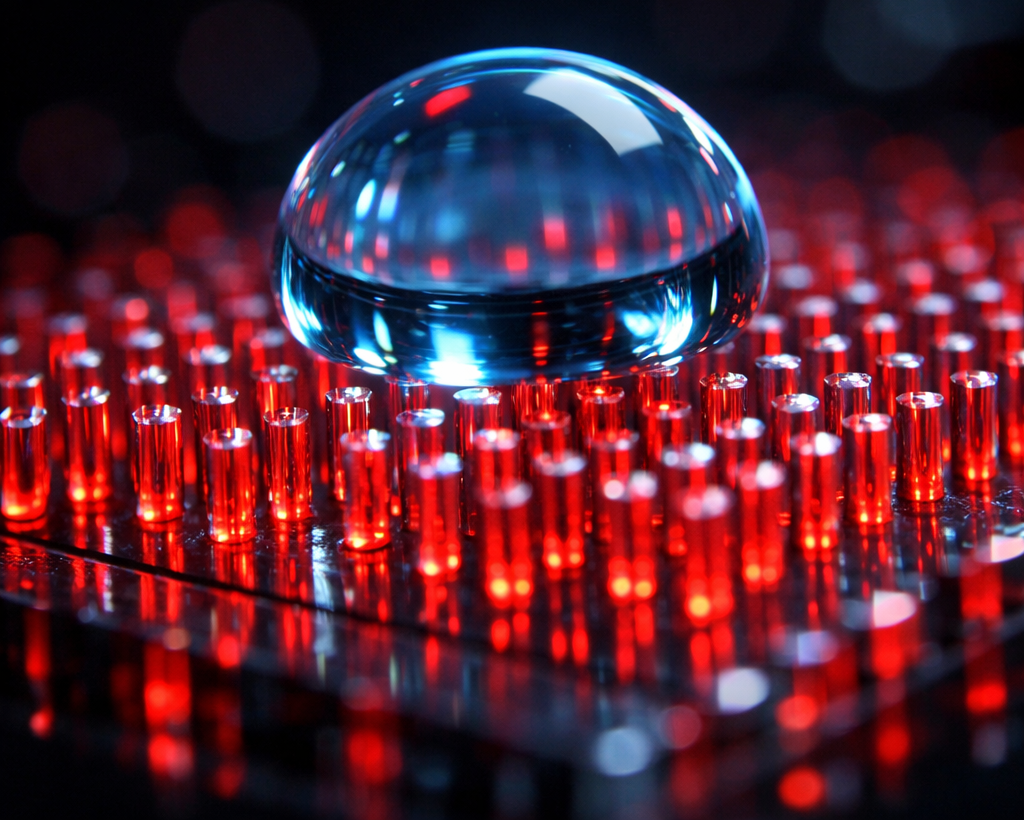
Nanopillars and gratings that boost photon collection and bring the sensor closer to the sample.
Micro-NMR & Microfluidics
Integrated chips for NMR detection of picolitre samples with controlled sample handling.
The Quantum Sensor
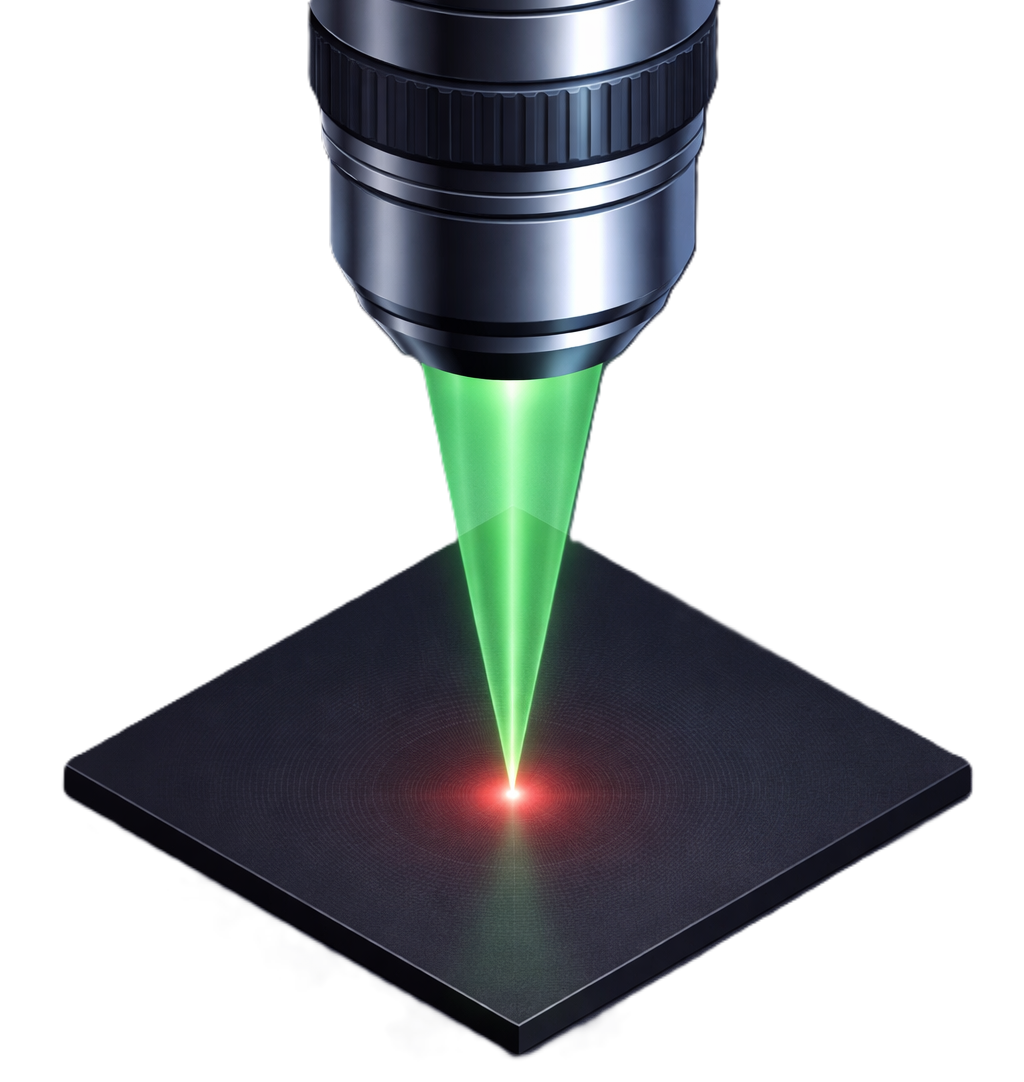
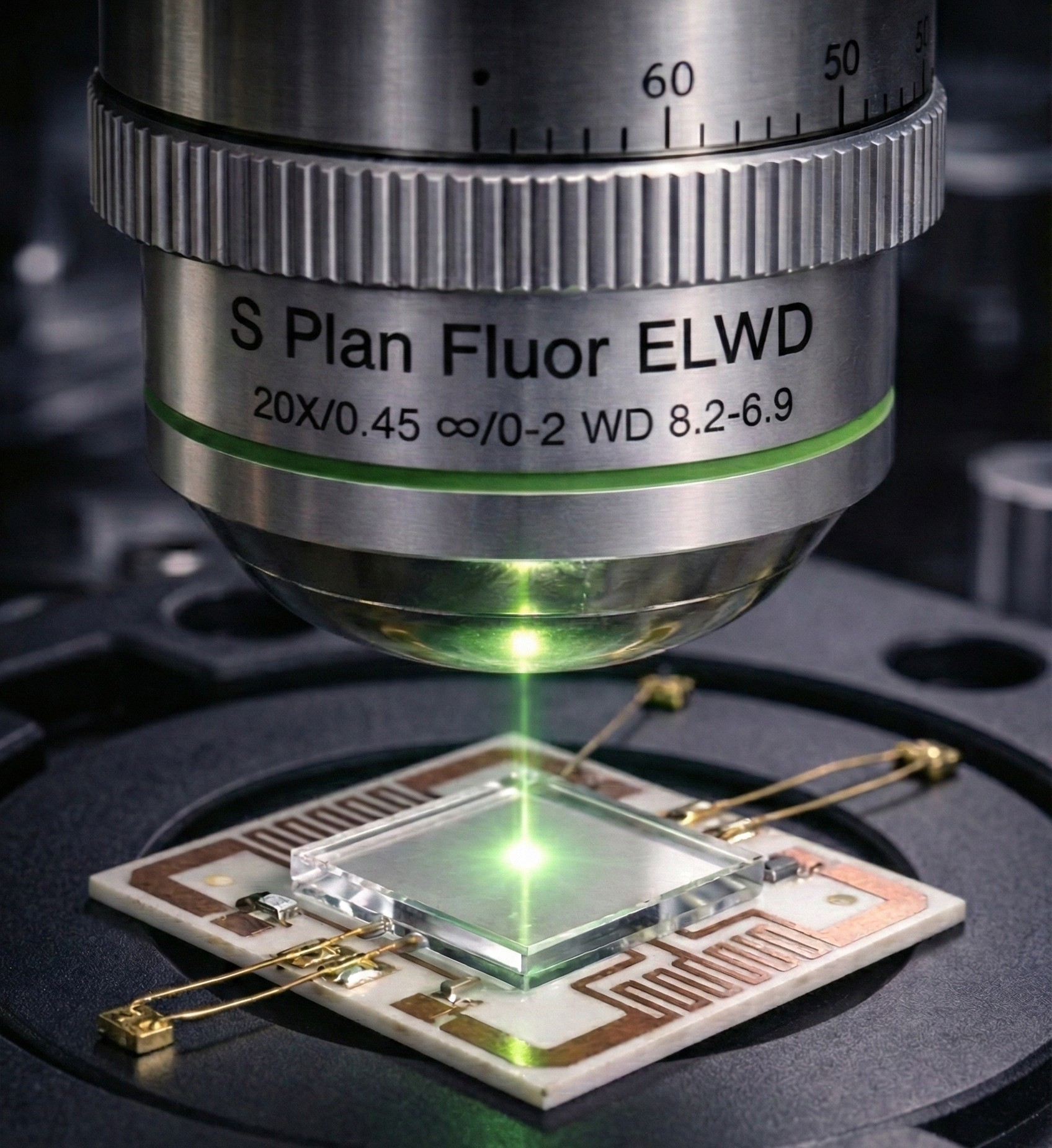
At the heart of our research is the nitrogen-vacancy (NV) centre in diamond: an atomic defect whose electron spin behaves like a tiny compass needle. We steer the spin with microwave pulses and read it out with light — green laser in, red fluorescence out. Shielded by the diamond lattice, the NV centre keeps its quantum coherence even at room temperature, making it a high-sensitivity magnetometer that needs no cryogenics.
- Room temperature: operates in ambient conditions — no cryostats, no superconducting magnets.
- Optical readout: a green laser initializes the spin; the intensity of the red fluorescence reveals its state.
- Atomic size: the sensor is a single lattice defect, enabling nanometre-scale spatial resolution.
Nanostructuring & Fabrication
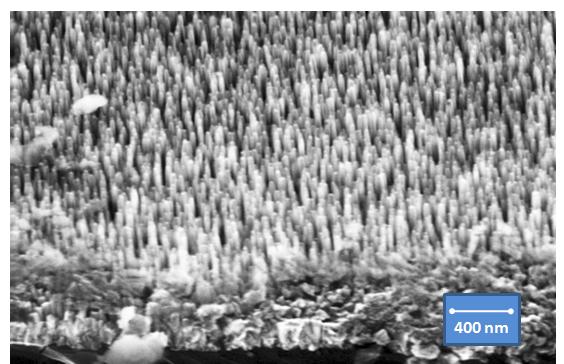
A sensor is only as good as its distance to the sample. To bring NV centres within nanometres of what we measure — and to collect as much of their fluorescence as possible — we sculpt diamond into functional nanostructures such as nanopillars and gratings.
We work closely with the group of Prof. Alexander Kromka at the Institute of Physics of the Czech Academy of Sciences (FZU).
- CVD growth: high-purity single-crystal diamond grown by chemical vapour deposition.
- Nanofabrication: plasma etching of diamond into photonic structures.
- Surface termination: controlling surface chemistry to preserve spin coherence.
The Experiment: Micro-NMR
Conventional NMR spectroscopy needs a massive superconducting magnet to analyse millilitres of sample. We are building the opposite: a compact, integrated NV-diamond platform that detects the chemical composition of picolitre volumes — thin films, microfluidic channels, ultimately single cells — using permanent magnets on an ordinary optical table.
Open Positions / Thesis Topics
We are looking for motivated students at every level — projects can be scaled to a Bachelor project, an MSc thesis, or a PhD. You will build real hardware in a newly equipped lab: optics, microwave electronics, diamond photonics, and Python-driven experiment control.
- Design and construction of an integrated NV–NMR spectrometer.
- Optimization of microwave antenna designs for efficient spin control.
- Investigation of surface-termination effects on diamond spin coherence (T2).
- Nanostructuring of single-crystal diamond for enhanced photon collection.
- Development of Python-based automation for quantum sensing experiments.
How to apply
Send a short email to tomas.sikorsky@matfyz.cuni.cz with a line or two about what you would like to work on.