


Machine Learning
Infographics
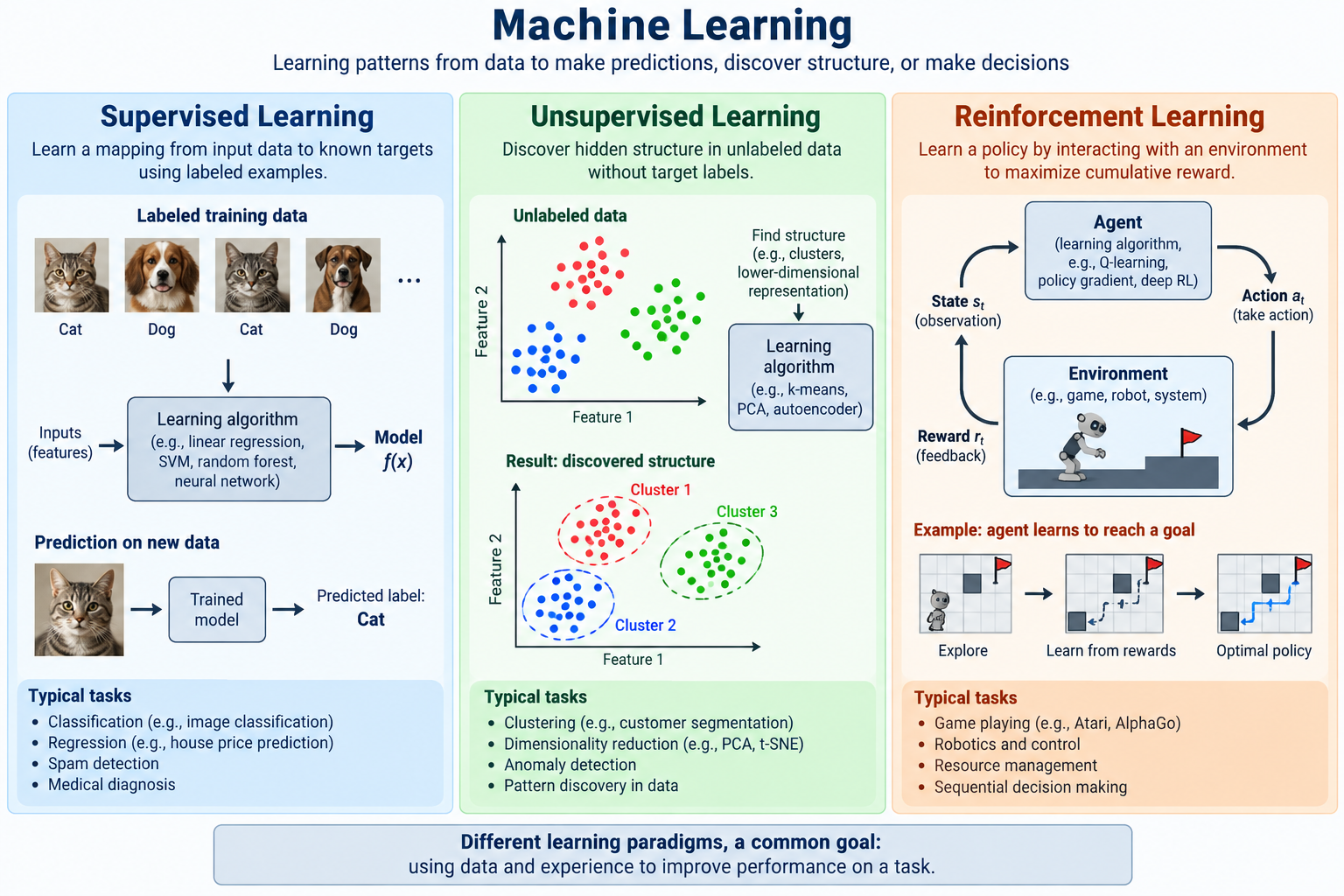
- Supervised Learning (Linear Regression, Logistic Regression, Decision Trees, Support Vector Machines, K-Nearest Neighbors, Naive Bayes)
- Unsupervised Learning (K-Means Clustering, Principal Component Analysis)
- Reinforcement Learning (Q-Learning)
Jupyter notebooks
- Machine Learning (Overview)
- Supervised Learning (Linear Regression, Logistic Regression, Decision Trees, Support Vector Machines, K-Nearest Neighbors, Naive Bayes)
- Unsupervised Learning (K-Means Clustering, Principal Component Analysis)
- Reinforcement Learning (Q-Learning)
Deep Learning
Infographics
- Feedforward Neural Networks (FFNN) / Multilayer Perceptrons (MLP)
- Convolutional Neural Networks (CNN) / ConvNets
- Recurrent Neural Networks (RNN)
- Long Short-Term Memory (LSTM) Networks
- Gated Recurrent Units (GRU)
- Autoencoders (AE)
- Generative Adversarial Networks (GANs)
- Transformer Networks (TN)
- Graph Neural Networks (GNNs)
- Residual Networks (ResNets)
- Densely Connected Convolutional Networks (DenseNets)
Jupyter notebooks
- Neuron (Perceptron)
- Activation Functions
- Neural Network Architecture
- Loss Function (Cost Function)
- Optimization Algorithm (Gradient Descent)
- Backpropagation
- Feedforward Neural Networks (FFNN) / Multilayer Perceptrons (MLP)
- Convolutional Neural Networks (CNN) / ConvNets
- Recurrent Neural Networks (RNN)
- Long Short-Term Memory (LSTM) Networks
- Gated Recurrent Units (GRU)
- Autoencoders (AE)
- Generative Adversarial Networks (GANs)
- Transformer Networks (TN)
- Graph Neural Networks (GNNs)
- Residual Networks (ResNets)
- Densely Connected Convolutional Networks (DenseNets)

AI Agents and Scientists
Infographics
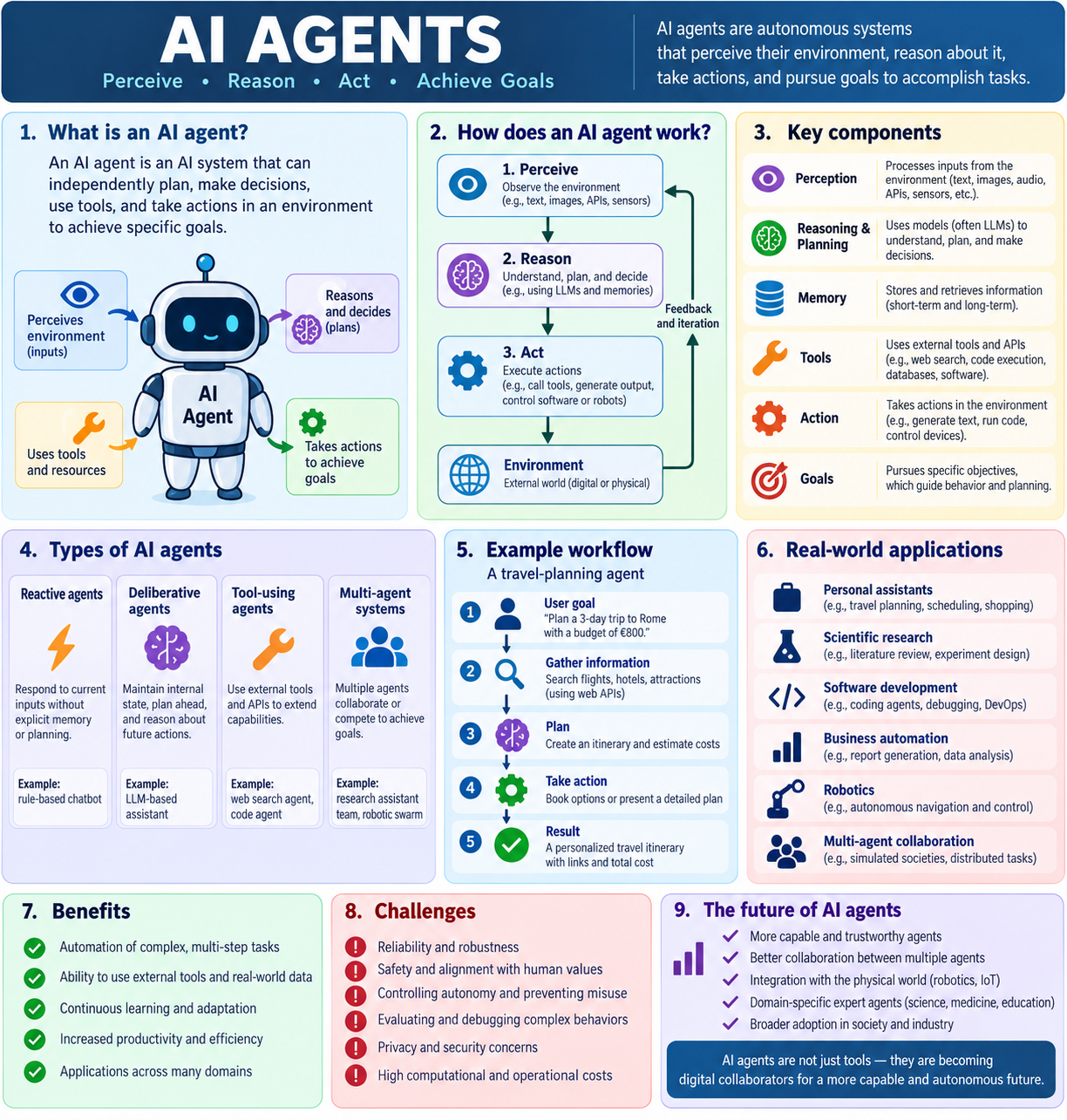
- AI Agents (§0 The loop §1 Formal setting §2 Lab: Bellman §3 Reasoning & planning §4 Tools & memory §5 Learning to act §6 Multi-agent §7 Evaluation §8 Open problems §9 Reading list)
- AI Scientists (The loop Formalism Reliability False discovery Tournaments Systems Autonomy Failure modes For your PhD Reading)
→ First LLM-driven discovery on an open maths problem
→ Tool use as the route to domain competence
→ ≈ $15 per paper; later published in Nature (2026)
→ Human feedback improved output quality
→ Generate → debate → evolve
→ A fully generated paper passed ICLR 2025 workshop review
→ Beat Strassen's 1969 bound of 49 for this case
→ Hypothesis → assay → analysis loop
→ 79.4% of statements judged accurate
Jupyter Notebooks
References
Machine-Learned Force Fields
Infographics
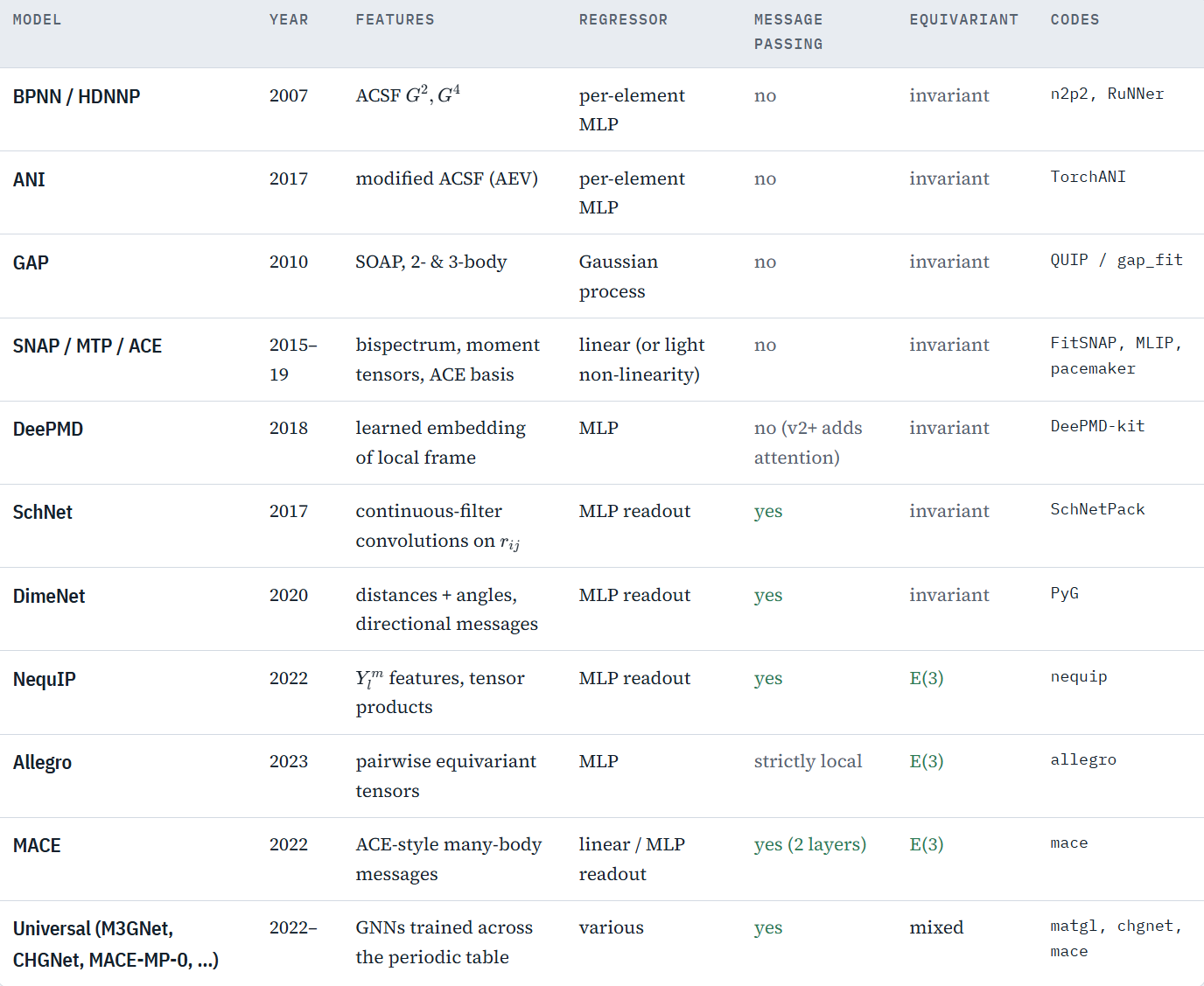
- J. Behler, M. Parrinello, Generalized neural-network representation of high-dimensional potential-energy surfaces, Phys. Rev. Lett. 98, 146401 (2007). doi
- A. P. Bartók, M. C. Payne, R. Kondor, G. Csányi, Gaussian approximation potentials, Phys. Rev. Lett. 104, 136403 (2010). doi
- A. P. Bartók, R. Kondor, G. Csányi, On representing chemical environments (SOAP), Phys. Rev. B 87, 184115 (2013). doi
- J. S. Smith, O. Isayev, A. E. Roitberg, ANI-1: an extensible neural network potential with DFT accuracy at force field computational cost, Chem. Sci. 8, 3192 (2017). doi
- K. T. Schütt et al., SchNet – A deep learning architecture for molecules and materials, J. Chem. Phys. 148, 241722 (2018). doi
- L. Zhang, J. Han, H. Wang, R. Car, W. E, Deep potential molecular dynamics, Phys. Rev. Lett. 120, 143001 (2018). doi
- R. Drautz, Atomic cluster expansion for accurate and transferable interatomic potentials, Phys. Rev. B 99, 014104 (2019). doi
- S. Batzner et al., E(3)-equivariant graph neural networks for data-efficient and accurate interatomic potentials (NequIP), Nat. Commun. 13, 2453 (2022). doi
- I. Batatia et al., MACE: Higher order equivariant message passing neural networks for fast and accurate force fields, NeurIPS (2022). arXiv:2206.07697
- A. Musaelian et al., Learning local equivariant representations for large-scale atomistic dynamics (Allegro), Nat. Commun. 14, 579 (2023). doi
- T. W. Ko, J. A. Finkler, S. Goedecker, J. Behler, A fourth-generation high-dimensional neural network potential with accurate electrostatics including non-local charge transfer, Nat. Commun. 12, 398 (2021). doi
- O. T. Unke et al., Machine learning force fields, Chem. Rev. 121, 10142 (2021). doi
- J. Behler, Four generations of high-dimensional neural network potentials, Chem. Rev. 121, 10037 (2021). doi
- X. Fu et al., Forces are not enough: Benchmark and critical evaluation for machine learning force fields with molecular simulations, TMLR (2023). arXiv:2210.07237
- I. Batatia et al., A foundation model for atomistic materials chemistry (MACE-MP-0), arXiv:2401.00096
Jupyter Notebooks
References
Useful links
MetaCentrum
History
- 2026 The Road to Modern AI
- 1965 Speculations Concerning the First Ultraintelligent Machine
- 1955 A PROPOSAL FOR THE DARTMOUTH SUMMER RESEARCH PROJECT ON ARTIFICIAL INTELLIGENCE

Gallery


